Categories Blog

When Parents Show Up, Children Stay in School


Empowered Voices Project  ·  Child Protection & Safeguarding

When Parents Show Up,
Children Stay in School

A record-breaking PTA gathering at Ruva Primary School in Arua City is showing what happens when a whole community decides every child deserves to finish school.

Arua City · West Nile, Uganda | March 2026 | 120 Community Members
Implemented by Amani Initiative · Empowered Voices Project · Girls First Fund · Dream Achievers Club

A school is only as strong as the community that stands behind it. When parents, teachers, and leaders sit together and decide that every child deserves to finish school — that decision changes lives.

Too Many Children in Uganda Never Make It to the End

Uganda has made real progress in getting children into school. But getting them to finish? That is a different story. Despite free primary education, 45% of primary school children in Uganda drop out before completing the full cycle. The UNESCO 2026 Global Education Monitoring Report confirmed it plainly: enrolment is high, but too many children fall through the cracks before they reach Primary Seven.

Here in West Nile, the pressure is even greater. Classrooms are stretched, with 107 pupils for every classroom in the region — one of the highest ratios in the country. And even though school fees were abolished under the Universal Primary Education programme, 6 in every 10 families still say the cost of schooling is why their child dropped out. From exercise books to meals to transport — the expenses add up fast for families already living on very little.

For girls, the challenge is even steeper. Research focused on Arua and the wider West Nile region found that social expectations — household chores, early marriage, and limited family support — are the biggest reasons girls leave school early. In parts of Arua District, more than 6 in every 10 girls who drop out are girls. Across Uganda, 28% of girls in rural areas leave school before completing primary education. These are not just numbers. Each one is a child whose future was cut short.

This is the reality Amani Initiative is working to change — one school, one community at a time.

45%
of Uganda’s primary school children drop out before finishing their education
107:1
pupils per classroom in West Nile — among the most overcrowded ratios in Uganda
61.8%
of school dropouts in parts of Arua District are girls — more than boys at 38.2%
60%
of families say the cost of schooling is the main reason their child stopped attending

Five Years of Walking Alongside Ruva Primary School

Amani Initiative has been a partner to Ruva Primary School since 2020. We did not arrive with a fixed plan — we arrived with a question: what does this school and this community actually need to thrive?

Over the past five years, the answer has taken shape. Through the Empowered Voices Project and the Girls First Fund, we have helped the school put in place a strong Child Protection and Safeguarding Policy — clear guidelines that keep every child safe within the school walls. Through the Dream Achievers Club, children who were at risk of dropping out have been identified, supported, and encouraged to keep going — all the way to the end of primary school. And through ongoing work with parents, the school has built something that cannot be seen in a policy document but can be felt the moment you walk through the gate: a sense of shared ownership.

That sense of ownership was on full display in March 2026 — and it was extraordinary.

When parents see real improvements in a school — better results, a safer environment, a school that cares — they show up. They invest. They protect what they helped build. That is the quiet engine behind everything happening at Ruva Primary School today.


120 Voices, One Direction

In late March 2026, 120 community members gathered for the Ruva Primary School PTA meeting — the biggest turnout the school had ever seen. Parents, local leaders, church representatives, the school management team, and the Amani Initiative team all came together in one room. It was the kind of gathering that tells you something important is happening at this school.

The meeting was not just people sitting and listening. It was a real conversation — parents asking questions, sharing ideas, reviewing the school’s plans for the year ahead, and agreeing on the steps everyone would take together. The energy in the room was something that could not be manufactured. It was built, slowly, over five years of trust.

By the time the meeting closed, the community had not just received information. It had made decisions — together.

“The biggest turnout in the school’s history — parents who came not because they had to, but because they knew it mattered.”

Ruva Primary School PTA Meeting · March 2026

Real Change That Everyone Could See

The meeting was filled with good news — and some of it was completely unexpected.

Parents Noticed the Progress

Without being asked, parents stood up to share how much the school had improved — in pupils’ academic results, in the school’s environment, and in the way the school is run. When a community volunteers praise like that, it is a sign that real change has taken hold.

Everyone Is Working Together

One of the most encouraging things to observe was how well the school administration, parent leaders, management committee, and local council were coordinating. A school where everyone pulls in the same direction is a school where children thrive — and Ruva is becoming that school.

A Nursery Section — Born From Community Energy

This one was not planned. During the meeting, the community came together to celebrate the launch of a new nursery section within the school. Parents were excited — because reaching children from their earliest years means giving them the strongest possible start. It was a beautiful, unscripted moment of community pride.

Parents Want More — Not Less

At the end of the meeting, parents did not want to go home. Many asked for PTA meetings to happen more often. That is perhaps the clearest sign of all that something real has shifted: parents who once stayed away are now asking to be more involved.


Honest Conversations, Practical Solutions

A good PTA meeting does not only celebrate wins — it also creates space to talk honestly about what is not yet working. The Ruva community did exactly that, and came away with clear plans to address the challenges ahead.

The community discussed the need to improve security around the school, agreeing to put additional measures in place to keep the school safe for learners and staff. Issues around the use and condition of school facilities were raised openly — including how to better protect the school fence, manage the playground responsibly, and improve the learning environment in the nursery section. Concrete steps were agreed upon for each.

Parents and the school administration also had an honest conversation about school fees and financial support — recognising that while the government provides some funding, families also have a role to play in supporting their children’s education. A practical, learner-friendly approach to fee collection was agreed upon to make sure that no child misses class because of how fees are managed.

Wider community wellbeing was also acknowledged as something that affects children’s schooling. The meeting agreed to strengthen communication between teachers and families to make sure no child facing difficulties at home is left without support.


Commitments the Community Made Together

A great meeting is only great if it leads to action. The Ruva community walked away with a shared list of commitments — here are the key ones:

Commitment Status
Hold PTA meetings every school term to keep the community connected and informed Planned
Encourage parents to actively support the school alongside government funding Planned
Strengthen regular communication between teachers and parents through home visits In Progress
Put a learner-friendly system in place for how school fees are collected Planned
Mobilise community resources to improve the nursery and school infrastructure In Progress
Establish clear guidelines for use of school facilities to protect them Planned
Follow up regularly on agreed resolutions to make sure progress is made Planned

When a Community Owns Its School, Children Win

What happened at Ruva Primary School in March 2026 was more than a school meeting. It was a community saying: we care about this place, and we are going to protect it.

In a region where nearly half of all children never finish primary school, that kind of community energy is one of the most powerful tools we have. When parents show up in record numbers, it tells children that their education matters. When local leaders sit with school staff and agree on solutions together, problems get solved faster. When a girl in Arua City grows up surrounded by adults who are invested in her future — she is far more likely to reach Primary Seven, to sit her exams, and to keep going.

This is what Amani Initiative’s partnership with Ruva Primary School is really about. Not a single project, not a single meeting — but a lasting relationship that builds the kind of school community where every child belongs, every child is safe, and every child has a real chance to finish what they started.

We are proud of how far this community has come. And we are excited about where they are going.

Help More Children Finish School

Amani Initiative partners with schools and communities across Arua City and the West Nile region to protect children, strengthen school governance, and keep learners — especially girls — in the classroom. Want to learn more or join us in this work? We would love to hear from you.

✉ info@amaniinitiative.org
#EmpoweredVoices #AmaniInitiative #GirlsFirstFund #DreamAchieversClub #ChildProtection #Arua #WestNile #KeepGirlsInSchool #Uganda #SDG4

Ruva Primary School · Arua City, West Nile, Uganda · March 2026
Contact us: info@amaniinitiative.org

Statistics: UNESCO Global Education Monitoring Report 2026 · ICRW West Nile Dropout Study · UBOS 2021 · Imvepi Refugee Settlement School Study, Makerere University

Categories Blog

When He Shows Up, Lives Are Saved:The Case for Male Engagement in Maternal and Infant Health

Health & Wellness Program · Maracha District, Uganda

When He Shows Up, Lives Are Saved:
The Case for Male Engagement in Maternal and Infant Health

A community dialogue in Ajira village, Maracha District, is opening a long-overdue conversation — and showing us what is possible when men and women walk the journey of pregnancy together.

Maracha District · West Nile, Uganda Maternal Health & Male Engagement Amani Initiative
Implemented by Amani Initiative under the Women’s Voice and Leadership (WVL) Project with support from CARE International – Uganda · Health & Wellness Program

My husband didn’t want me to go alone — but now he escorts me. That one change made all the difference.

Uganda’s Maternal and Infant Health:
A Crisis We Can No Longer Ignore

Every year in Uganda, thousands of women die from causes that are almost entirely preventable. According to UNICEF’s 2024 Annual Report, Uganda’s maternal mortality ratio has fallen significantly — from 336 deaths per 100,000 live births in 2016 to 189 deaths per 100,000 live births in 2022. That is real progress, and it deserves recognition. But it also means that hundreds of mothers still lose their lives each year in the act of bringing new life into the world. UNFPA estimates that approximately 6,000 women and adolescent girls still die every year from preventable causes related to pregnancy and childbirth in Uganda — and that for every woman who dies, an estimated 20 to 30 more suffer injuries, infections, or lifelong disabilities.

Infants pay an equally devastating price. Uganda’s infant mortality rate stands at 36 deaths per 1,000 live births, with 42% of those deaths occurring in the fragile first days of life — the neonatal period when the quality and timeliness of antenatal care matters most. In Northern Uganda and West Nile, where Maracha District is located, these numbers have historically been even more severe, with some districts recording maternal mortality ratios far above the national figure.

The painful truth is that many of these deaths share a common thread: they happen when care comes too late, or not at all. And behind that delay is often a story not just about geography or poverty — but about who in the household holds the power to decide whether a pregnant woman goes to a health facility, and whether she goes alone.

189
maternal deaths per 100,000 live births in Uganda (2022) — down from 336 in 2016, but still far too high
6,000
women and adolescent girls die every year in Uganda from preventable pregnancy and childbirth complications
36
infant deaths per 1,000 live births — 42% occurring in the neonatal period when early ANC matters most
24.3%
of pregnant women in Uganda attend their first ANC visit within the critical first trimester

The Missing Half: Why Men Must Be Part of the Journey

For generations, pregnancy in Uganda has been treated as a woman’s affair. Men drop women at the gate of a health facility — if they accompany them at all — and return to their daily routines while their partners face health workers, waiting rooms, and anxiety alone. This is not merely a cultural norm. It is a public health problem with measurable, deadly consequences.

Research conducted across sub-Saharan Africa finds that fewer than half of all men are involved in antenatal care with their partners, with an average of around 45.7% of men attending at least one ANC visit together across eight African countries. In some parts of Uganda, that figure has been as low as 6%. Even in communities where men attend at least once, fewer than 10% accompany their partners for four or more visits — the minimum recommended for a well-monitored pregnancy.

Yet evidence is equally clear about what happens when men do show up. Studies across Uganda and East Africa consistently show that women whose partners are involved in ANC are more likely to attend early and regularly, more likely to deliver with a skilled birth attendant, more likely to receive timely HIV counselling and care, and less likely to experience dangerous delays in seeking emergency obstetric care. Male involvement in ANC has been directly linked to improved maternal outcomes, reduced maternal anxiety, and healthier newborns. Uganda recognised this formally in 2014 when it launched a National Male Involvement Strategy in Maternal and Child Health — yet implementation at the community level in areas like Maracha remains a work in progress.

The barriers are real but surmountable. Distance to health facilities, long waiting times, unfriendly clinic environments, fear of HIV testing as a couple, and deeply held cultural beliefs that pregnancy is a “woman’s matter” all discourage men from stepping forward. But they can be addressed. And in Ajira village, that addressing has begun.

Research from Northern Uganda confirms that men who are knowledgeable about ANC services and obtain health information from facility health workers are nearly three times more likely to attend antenatal care with their spouses. Information changes behaviour. Dialogue changes communities. And communities that change, save lives.

A Conversation That Could Change Everything

On 23rd March 2026, Amani Initiative — under the Women’s Voice and Leadership (WVL) Project supported by CARE International Uganda, as part of its Health and Wellness Program — brought together 35 community members at the Ajira sub-county headquarters in Olupi Parish, Maracha District. They came from different walks of life: women from the Nzakai Terracing VSLA Group, community members of Tara sub-county, and health workers who brought data, candour, and commitment to the conversation.

It was a participatory dialogue — not a lecture, not a workshop, but a genuine community conversation. And within it, something important happened. People spoke the truth. About fear. About distance. About husbands who stay home while wives face labour alone. About health workers who, on bad days, use words that send women away rather than drawing them in. About the poverty that means a woman cannot afford a basin or a set of clothes for her baby, so she delays going to the clinic rather than arrive with nothing in her hands.

Health workers shared the ANC attendance data they had been quietly recording, and the numbers were sobering. In December 2025, only 12 women attended ANC — accompanied by just 2 men. By February 2026, attendance had risen to 53 women and 25 men. Progress, yes. But still far from the universal couple engagement that research tells us is needed to truly protect mothers and infants in this community.

The dialogue identified the barriers clearly. And in naming them together — men, women, health workers, and community leaders in the same room — the community began the work of dismantling them.

Month Women Attending ANC Men Accompanying Partners
December 2025 12 2
January 2026 48 18
February 2026 53 25
Source: Ajira Sub-County Health Facility Records · Community Advocacy Dialogue, March 2026

The trend is encouraging — attendance is rising, and male accompaniment is growing. But the gap between the number of women attending and the number of men joining them makes the work ahead clear. In February, 25 men accompanied 53 women — meaning fewer than half of the women attending ANC had their partners beside them. In a community where household decision-making about health, finances, and movement often runs through men, that gap has consequences that reach far beyond a single clinic visit.


Barriers Named, Solutions Imagined

The dialogue in Ajira was honest in ways that formal surveys rarely capture. Community members spoke freely about what keeps pregnant women — and their partners — away from antenatal care. These are not excuses. They are real structural and social barriers that any serious public health response must grapple with.

Fear and Stigma

Young girls expressed fear about disclosing pregnancies, while many couples described the stigma of testing positive for HIV at a health facility as a powerful deterrent to attending together. When a clinic visit feels like an exposure rather than a support, couples stay away — and the risks that ANC is designed to catch go undetected.

Distance and Access

Ajira sub-county is one of Maracha’s hard-to-reach areas. For many families, the health facility is not a short walk but a significant journey — made harder by poor roads, unpredictable weather, and the cost of transport that many households cannot afford. Mr. Atama Joel, 27, put it plainly at the dialogue: “The health workers are friendly. But sometimes the distance is a challenge.”

Negative Attitudes Among Men

Many men in the community carry deeply held beliefs that the antenatal clinic is a space for women — “a room for checking pregnant women,” as some described it. This perception, combined with the long waiting times common at understaffed facilities, discourages men from accompanying their partners even when they are willing in principle.

Poverty and Lack of Planning

Participants described how poverty prevents early ANC attendance in a very specific way: women delay going to the clinic because they cannot afford the materials they are expected to bring — clothes, basins, and other items for the baby. The shame of arriving unprepared keeps them at home, sometimes until the pregnancy is dangerously advanced.

Unfriendly Health Worker Attitudes

Several community members mentioned that some health workers use abusive or dismissive language when speaking to patients, creating an atmosphere of fear rather than welcome. This is a systemic issue that no amount of community sensitisation alone can solve — it requires investment in health worker training, accountability, and patient-centred care standards.


What People Are Already Saying

Some of the most powerful moments in the Ajira dialogue came not from data or expert presentations, but from the people in the room sharing their own truths. Two voices in particular capture the spirit of what is changing — and what can change — when communities speak openly about maternal health.

“My husband didn’t want me to go alone, but now he escorts me.”

Mrs. Candiru Jane, 24 · Dialogue Participant

“Now as grandparents, we regularly advise our children to go for early antenatal care services for safe delivery with no health complications.”

Mr. Anguyo Paul, 46 & Mrs. Ezatiru Rose, 52 · Community Well-wishers

These voices matter. Mr. Anguyo and Mrs. Ezatiru were not even invited — they came of their own accord, drawn by the significance of the conversation happening in their community. That two grandparents would show up uninvited to advocate for early antenatal care for the next generation is not a small thing. It is a community beginning to shift its norms from the inside. That is the hardest and most durable kind of change.

“Involving husbands and family members in antenatal care education can encourage women to attend ANC. We have seen it work — and we need to make it the rule, not the exception.”

Community Recommendation · Ajira Advocacy Dialogue, March 2026

What Men, Women, and Communities Can Do Together

The community dialogue in Ajira concluded with a set of recommendations that were not handed down from above, but rose from the community itself. They are simple, practical, and powerful — and they tell us exactly what is needed to protect maternal and infant health in Maracha District and across West Nile.

Men must choose to show up. Not because they are told to, but because they understand that pregnancy is not their partner’s journey alone. It is a shared journey — and its outcome depends on shared care. A man who escorts his wife to ANC, who sits with her in the waiting room, who hears from the health worker about danger signs and nutrition and delivery planning, becomes a partner in the truest sense. He becomes part of the safety net that can make the difference between a safe delivery and a tragedy.

Health facilities must become welcoming spaces for couples. Community members were clear: health workers who speak with kindness draw patients in. Those who use harsh words push patients away — sometimes permanently. Investing in patient-centred care, couple-friendly ANC services, flexible clinic hours, and privacy for couples discussing sensitive matters like HIV testing are not luxuries. They are prerequisites for the male involvement that saves lives.

Community leaders — religious, traditional, and local government — must make maternal health a consistent public message. Participants called for sensitisation on the importance of early ANC to be built into every public gathering, every church service, every community meeting. When the message comes from trusted voices within the community, it lands differently than when it comes from a poster on a clinic wall.

Women must be supported to attend without shame. The poverty-driven fear of arriving at a clinic without materials for the baby is a solvable problem — through VSLA savings schemes, community support networks, and health facility policies that welcome women regardless of what they bring with them. No woman should delay life-saving care because she cannot afford a basin.

The data is clear. The evidence is compelling. And in Ajira village, the conversation has already begun. What happens next depends on all of us — men and women, health workers and leaders, grandparents and young couples — deciding that maternal and infant health is everyone’s responsibility, not just the woman’s burden to carry alone.

Be Part of the Change

Amani Initiative’s Health and Wellness Program is working with communities across Maracha District — and beyond — to build a Uganda where no woman faces pregnancy alone, and no child dies from a preventable cause. If you believe in this work, we want to hear from you.

Support our Health & Wellness Program and wider community health work — reach us directly.

#HealthAndWellness #AmaniInitiative #MaternalHealth #MaleEngagement #EndMaternalMortality #WestNile #Maracha #CAREUganda #Uganda #SDG3 #WomensHealth

Community Advocacy Dialogue · Ajira Village, Olupi Parish, Maracha District · March 2026
Contact: info@amaniintiative.org

Statistics drawn from: UNICEF Uganda Annual Report 2024 · UNFPA Uganda · Uganda Demographic and Health Survey 2022 · BMC Pregnancy & Childbirth (Hoima Study) · Ajira Sub-County Health Facility Records 2025–2026

Categories Blog

From Soap to Sovereignty:How Skills Training Is Turning the Tide on Gender-Based Violence


Voices for Strength Project · West Nile, Uganda

From Soap to Sovereignty:
How Skills Training Is Turning the Tide on Gender-Based Violence

57 women from the Pakayo-Amudrile and Alarapi-Asianzu VSLA Groups are rewriting their futures — one bar of soap at a time.

West Nile Sub-Region, Uganda Economic Empowerment & GBV Prevention Livelihood Skills Training
Implemented by Amani Initiative through the Feminist Humanitarian Network with financial support from the Irene M. Staehelin Foundation

When a woman can feed her children, pay school fees, and save her own money, she is no longer negotiating from a place of desperation. She negotiates from a place of dignity — and dignity is the first shield against violence.

A Sub-Region Facing a Silent Crisis

The West Nile sub-region of Uganda is a place of extraordinary resilience. Its communities have absorbed waves of displacement, conflict, and economic hardship with remarkable grace. Yet behind that resilience lies a troubling reality: gender-based violence remains one of the most persistent and devastating challenges facing women and girls across the sub-region — and the numbers reveal just how deep the crisis runs.

Police records show that West Nile districts — Arua, Nebbi, Koboko, Zombo, Maracha, and Pakwach — have logged thousands of documented GBV cases in recent years, with Arua alone recording 611 cases in a single year. But these are only the reported figures. Experts agree that the true scale of violence is far higher, suppressed by stigma, cultural norms, and a widespread belief that domestic violence is a private family matter rather than a criminal one. Across Uganda, a staggering 40 GBV cases are reported to police every single day — and each one represents many more that go unreported in silence.

In the refugee-hosting communities of West Nile — which shelter hundreds of thousands of South Sudanese and Congolese refugees — the crisis deepens further still. Unaccompanied women, single mothers, and girls face compounded vulnerability. The 2016 Uganda Demographic and Health Survey found that 64% of women aged 15–49 in the West Nile sub-region had experienced physical or sexual violence — a figure that towers above the national average of 51% and speaks to the particular weight this community carries.

The drivers are well-documented: alcohol abuse, harmful cultural norms, land disputes, widow inheritance practices, and — threaded through all of it — economic desperation. Poverty traps women in violent situations. And that is precisely where the Voices for Strength Project enters.

15,184
domestic violence victims reported across Uganda in 2023 — women constituting the vast majority
64%
of women aged 15–49 in West Nile have experienced physical or sexual violence — well above Uganda’s 51% national average
40+
GBV cases reported every single day across Uganda, per the 2023 Uganda Police Crime Report
74%
of women in Uganda have experienced some form of GBV — nearly double the global average of 35%

Economic Power as Protection

There is a connection that research across sub-Saharan Africa has confirmed with growing consistency: when women gain economic independence, their vulnerability to violence decreases. This is not coincidence. It is cause and effect.

Economic dependency is one of the most powerful tools of control in abusive relationships. When a woman has no income, no savings, and no marketable skill, the decision to leave a violent home is not simply emotional — it is practically impossible. She cannot feed her children. She cannot pay rent. She has nowhere to go. But when she has a skill, a product, and a buyer — the calculation changes entirely.

A landmark study conducted in Uganda demonstrated that economic empowerment interventions — including savings programs and vocational training — significantly reduced both emotional and physical intimate partner violence among participants. Evidence from Liberia found that vocational skills training reduced emotional IPV by 23 percentage points among women who participated compared to those who did not. Panel research across sub-Saharan Africa has confirmed that increased female economic participation holds a long-run negative relationship with the gender inequality index — meaning that as women earn more, gender-based violence measurably declines over time.

The World Bank, responding to GBV patterns in Uganda’s refugee-hosting districts — including those in West Nile — has directly recommended economic empowerment for women and girls as a primary prevention strategy. Uganda’s own National Development Plan III sets an ambitious target of reducing GBV prevalence by 30% by 2025, with women’s economic empowerment as a cornerstone of that goal.

This is the theory of change at the heart of the Voices for Strength Project, implemented by Amani Initiative through the Feminist Humanitarian Network with support from the Irene M. Staehelin Foundation. It is not enough to tell women they deserve safety. We must give them the tools to build it — the skills, the income, and the community of solidarity to stand on their own terms.

Hands, Knowledge, and Hope in Every Bar

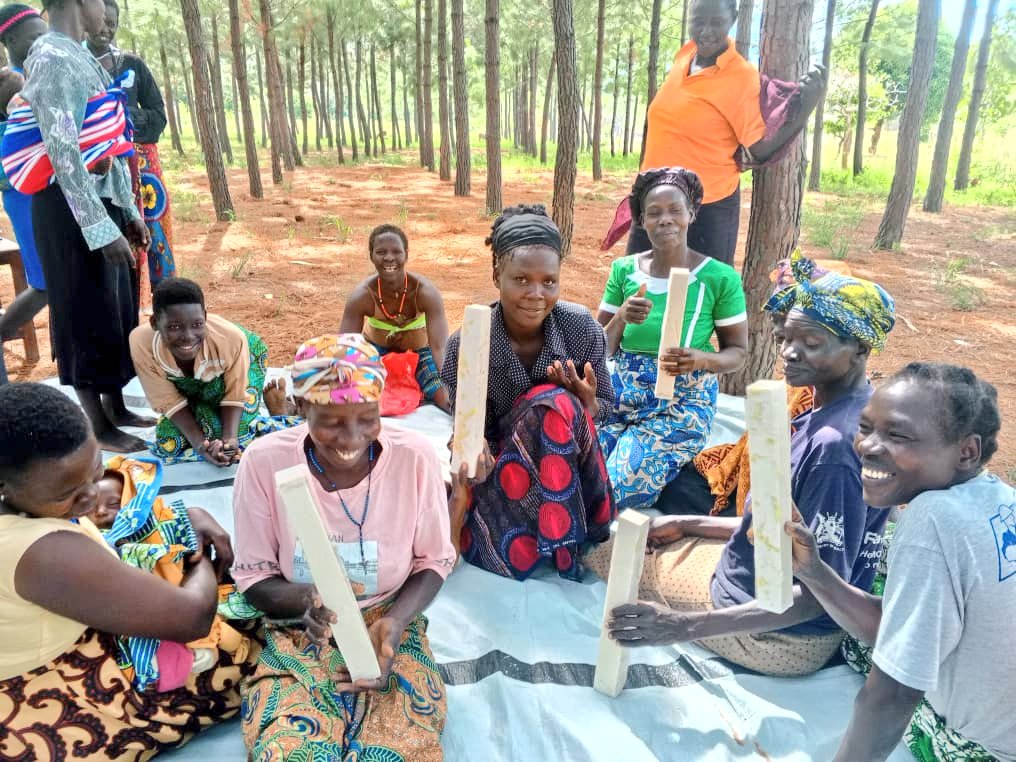
In a participatory training session held across two communities, women from the Pakayo-Amudrile and Alarapi-Asianzu Women VSLA Groups gathered to acquire one of the most practical and marketable livelihood skills in Uganda’s local economy: bar soap making.

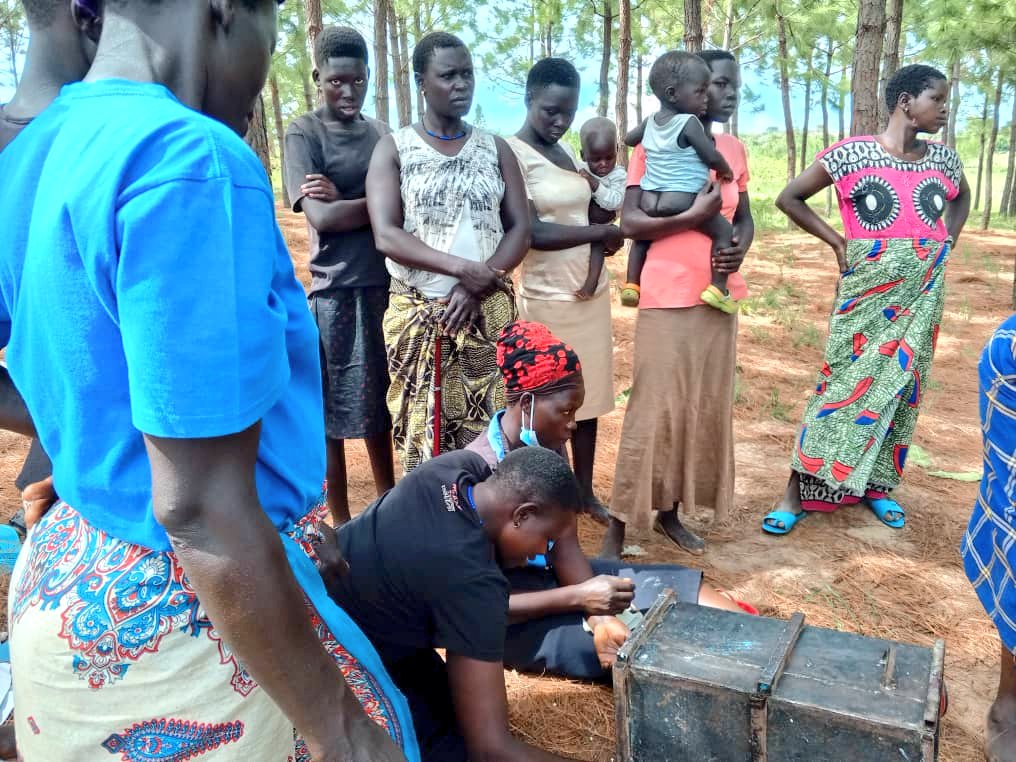
The training was not a lecture. It was a workshop — sleeves rolled up, hands in the mix, questions asked and answered in real time. Guided by skilled facilitators, participants moved through the entire soap-making process from start to finish: proper chemical handling and safety during the mixing stage, quality control, moulding, curing, and packaging for market. They didn’t just learn to make soap. They learned to make sellable soap — a product that every household needs, every day, without exception.

What set this training apart was its insistence on the full picture. Beyond the technical process, participants received grounding in practical business education: how to price a product correctly, how to understand your market and your competitors, how to build consistent quality that earns buyer trust, and — critically — how to translate a skill learned in a single training session into a small business that generates recurring income month after month. Women discussed together how to pool resources through their VSLA groups, reduce production costs through collective purchasing, and access larger markets including schools, health facilities, and local retail outlets.

The room was alive with possibility. Women who arrived uncertain left with clarity — and with plans already taking shape, minds calculating what their first batch would cost, what it would earn, and what they would do with the difference.

“We didn’t just learn to make soap. We learned that we have the power to build something for ourselves — and for our children.”

Participant Reflection · Alarapi-Asianzu Women VSLA Group

Outcomes That Will Last

The results of this training go beyond what any table can fully capture. They live in the confidence of participants, in conversations that continued long after the session ended, and in plans being made across Pakayo and Alarapi. But there are concrete outcomes worth naming clearly.

Practical Skills in Bar Soap Making

Women and girls in both VSLA groups acquired comprehensive hands-on knowledge in bar soap production. From raw materials to a finished, packaged product, participants now hold a skill they can use tomorrow — and every day after that. This directly enhances their capacity for income generation and strengthens their ability to save and invest through their VSLA groups.

Safe Chemical Handling

Working with caustic soda and other chemicals requires care and precision. Participants gained critical knowledge in safe handling, correct proportioning, and protective practices during the soap production process — skills that protect their health, ensure product consistency, and position them as credible and professional producers in the eyes of buyers.

Business Mindset and Entrepreneurship

Technical skill without business knowledge is a half-built bridge. The training closed that gap. Participants left with a working understanding of pricing, market strategy, quality management, and customer trust — the foundational elements of any sustainable small enterprise. Many were already identifying their first customers before the session was over.

Aspiration to Diversify Income

One of the most encouraging outcomes was the appetite the training created for more. Participants expressed strong interest in learning liquid soap and shampoo production, seeing these as natural extensions of their newly acquired skills. Diversified products mean diversified income — and reduced financial vulnerability across seasons and shifting market conditions.

Strengthened VSLA Solidarity

Training as a group deepened the bonds within both VSLAs. The conversations that unfolded in the workshop — about quality, about markets, about supporting one another — are exactly the kind that transform a savings group into a resilience network. This social solidarity is itself a protective factor: connected women are less isolated, and less isolated women are safer.


57 Women. Countless Ripples.

The training directly reached 57 women — 30 from Alarapi Parish and 27 from Pakayo Parish. Among those reached were 9 women living with disabilities, reflecting the project’s deliberate commitment to inclusion and to leaving no one behind. All participants were members of the host community, ensuring that skills and economic momentum remain rooted in the local fabric of West Nile.

These 57 women are not just individual beneficiaries. They are mothers whose children will eat better. They are daughters showing the next generation what independence looks like. They are neighbours whose small businesses will circulate money and opportunity through their communities. Each skill learned ripples outward — and in a sub-region carrying the weight of West Nile’s GBV statistics, every ripple matters.

Age Group Host Community (Female) Women with Disabilities Total Reached
18 – 25 years 16 4 20
26 – 34 years 16 2 18
35 years and above 16 3 19
Total 48 9 57

The Economic Impact We Expect

Bar soap is not a luxury product. It is a daily necessity in every household — its demand is constant, its market is everywhere, and its production requires minimal equipment to begin. A woman who masters soap making and has access to start-up capital through her VSLA can begin generating income within days of completing training. When VSLA members collaborate — pooling resources to buy raw materials in bulk, sharing equipment, dividing production tasks — the economics improve further: lower costs, higher margins, more consistent quality, and access to institutional buyers that individual producers could not reach alone.

The immediate economic impact is household-level but real: money for school fees, money for healthcare, money set aside in savings that grows month by month. The medium-term impact, as women build customer bases and grow their enterprises, extends outward into their communities — creating local employment, stimulating the small trader economy, and demonstrating to other women that financial independence is not a dream. It is a skill and a plan away.

But perhaps the most significant economic impact is the one hardest to measure directly: the reduction in the cost of gender-based violence itself. GBV carries enormous economic weight — in lost productivity, in healthcare costs, in the trauma that passes from one generation to the next. Research confirms consistently that women who control their own income are better positioned to make decisions about their safety, to demand respect in their households, and to exit situations of violence when they become untenable. Every woman who earns her own income is, in a very real sense, investing in her own protection.

With the right follow-through — access to start-up capital, ongoing mentorship, and the additional skills trainings participants are already requesting — these 57 women are positioned to become proof of concept for the whole of West Nile. That safety and economic independence are not separate goals. That they are, in the end, the same journey.

There Are More Women Waiting.
Will You Walk With Them?

The women of Pakayo and Alarapi are just the beginning. Across West Nile, Amani Initiative works with many women’s groups under our Sustainable Livelihoods and Empowerment programs — groups that are ready to learn, ready to grow, and ready to build safer, more independent lives for themselves and their communities.

If this story moved you — if you believe, as we do, that a skill can be a lifeline — we would love to hear from you. Whether you are an individual, an organisation, or a funder, there is a role for you in this work.

Reach out to us directly and let’s explore how we can work together.

✉ info@amaniintiative.org

Amani Initiative · Sustainable Livelihoods & Empowerment Programs

#VoicesForStrength #AmaniInitiative #FeministHumanitarianNetwork #WomenEmpowerment #EndGBV #WestNile #VSLA #SkillsForLife #Uganda #SDG5

Voices for Strength Project · West Nile Sub-Region, Uganda
To support our women’s groups: info@amaniintiative.org

Statistics drawn from: Uganda Police Crime Report 2023 · World Bank GBV Assessment 2020 · Uganda Bureau of Statistics National Survey on Violence · Daily Monitor · Westminster Foundation for Democracy · Afrobarometer Uganda 2024