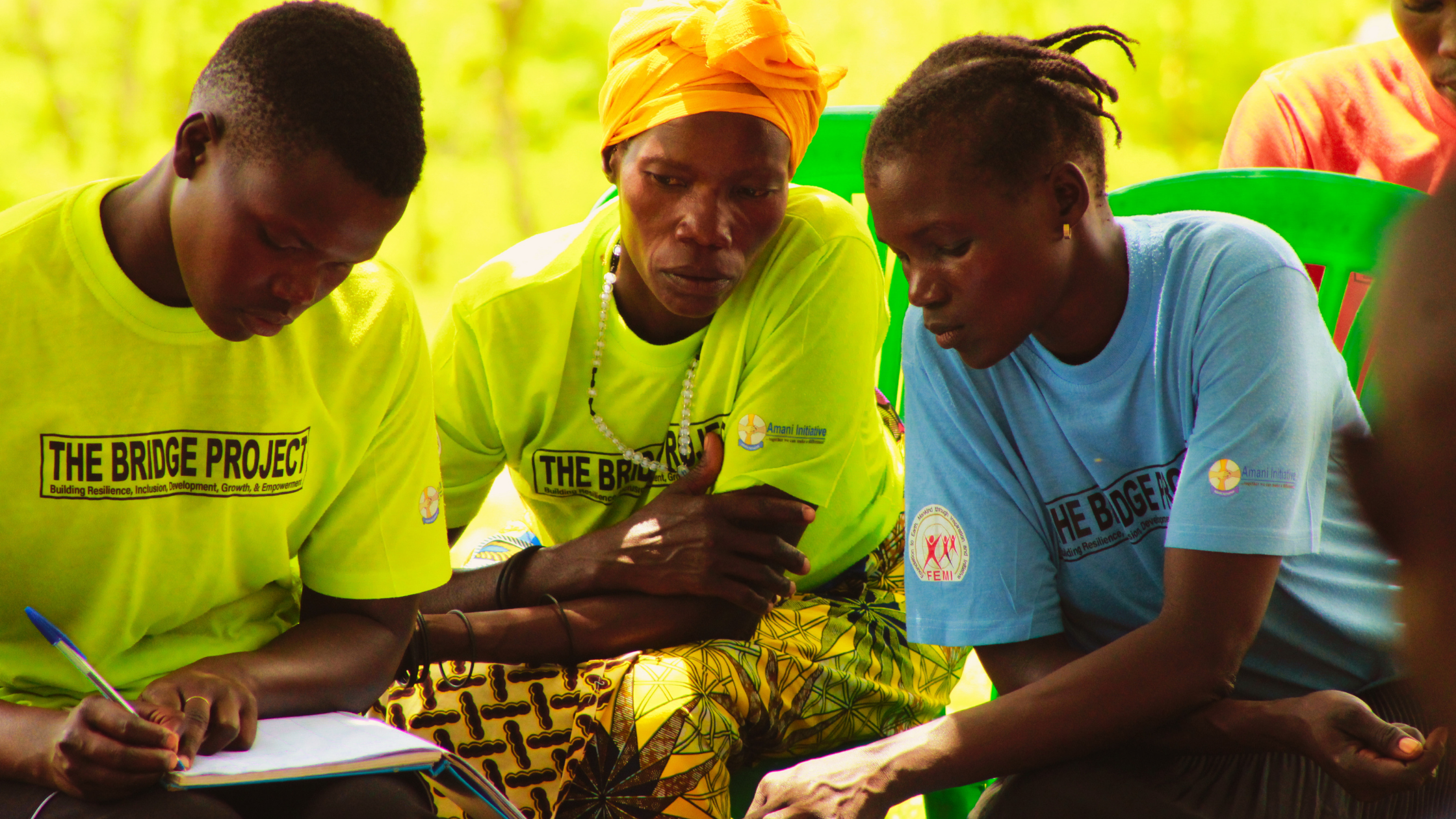

35 women. Two years. A bridge out of extreme poverty.
In Tara Sub-County, Maracha District, the BRIDGE Project walked beside 35 women and their families as they built businesses, savings and confidence. This is what changed.
Implemented by Amani Initiative with the support of FEMI Foundation, October 2024 to September 2026
Tara is a remote, hard-to-reach sub-county of more than 20,000 people. Farming depends on irregular rain. Most people left school at primary level. Where families have little, women and girls carry the heaviest load.
Most of the women we met had no capital, no ready market and no mobile phone. Many had spent years brewing local drink or selling small amounts of food just to get by. Poverty also pushes families toward child marriage and other harmful choices.
BRIDGE did not hand out aid and leave. For two years, Amani Initiative stayed with each household.
Peace: from no business to a growing rice trade
When BRIDGE began, Peace was 22. She had no business, only small-scale farming, and her resilience score was 23%, deep in the lowest band.
Today she buys and sells rice, four to five bags every week, with about UGX 10,000 profit on each bag. She also sells tomatoes, onions and cassava flour. Her goats have doubled from two to four. She keeps piglets and rents land to grow groundnuts and maize.
The profit pays her daughter’s school fees and her own tailoring course. She bought herself a smartphone. She says she now feels confident, independent and respected at home.
Resilience score: 23% to 100%. The biggest gain in the project: 77 points.
How BRIDGE worked
It started at home
Every family sat down with a facilitator, including husbands and children over 14, to name their goals. We returned eight times to check progress, reaching more than 180 family members.
Skills came before money
Eleven training sessions covered budgeting, record keeping, pricing, mobile money, digital safety and positive parenting. Hands-on lessons included bread, mandazi, liquid soap, smearing oil, charcoal briquettes and piggery.
Then start-up capital
Each household received UGX 1,000,000 (about €256), UGX 35 million in total. The women put it into livestock, trading, tailoring, grinding services and farming.
A group that lasts
The 35 women formed the Tara Ojataa Women’s Savings Group. It is registered with the Sub-County, has its own constitution and leaders, and meets every two weeks. It keeps going now that the project has ended.
The women also started a group business, OjataaCare Liquid Soap. They make it themselves and sell it directly. So far they have sold more than 900 litres and earned over UGX 830,000 (about €224) in profit.
Leaving no one behind was part of the plan. Women with disabilities and their children received white canes, protective shoes for those living with leprosy, accessible furniture and tricycles.
The results, in numbers that matter
We measured the same eight areas of household life at the start and at the end, so each woman was compared with her own starting point. Every single woman improved, by between 19 and 77 percentage points.
Of the 27 women who started in the lowest band, 23 are now highly resilient and four are moderate. All eight who started in the middle band are now highly resilient.
All eight areas passed the 75% mark for high resilience. The biggest gains were in income and food security, as women used business profits for food, school fees and healthcare. The total project budget was €20,891, about €600 for each woman and her household.
Meet the 35 women of BRIDGE
Behind every number is a woman and her family. Each score below is her average resilience at the start of the project and at the end. Ages are from the start of the project.
Knight Amviko
A 16-year-old running her own household and her own business
Resilience: 22% to 95%
At 16, Knight was a child raising a child, selling foodstuffs for UGX 15,000 to 20,000 a week. With her UGX 1 million start-up capital she bought a sewing machine and became a tailor. She now owns three goats and two pigs, rents land for beans and cassava, and saves UGX 5,000 every week.
Her financial management score rose from 6% to 94%, and decision-making from 31% to 100%. Now 18, she supports her household and decides how the money is used. Her next goal is a second sewing machine.
Agnes Alatiru
Building a better future for her seven children
Resilience: 49% to 89%
Agnes, 33, is a widow raising seven children. She used to brew local drink, earning UGX 15,000 to 30,000 a week, and her children sometimes missed up to 20 school days for lack of materials.
With UGX 1 million she moved into trading paste, cooking oil and simsim. She rents land for cassava, simsim and groundnuts, and owns two goats, pigs and a sheep. Food security rose from 25% to 100% and economic capacity from 30% to 95%.
Still needs support: coping and wellbeing, both at 75%.
Agnes Asibazuyo
From local brewing to a more secure future
Resilience: 35% to 95%
Agnes, 48, was brewing local drink. She was born without fingers, and her children were out of school. With start-up capital and financial literacy skills she diversified. She now sells rice, cooking oil and cassava flour, pays workers to cultivate her beans, cassava and sweet potatoes, and has grown her goats from four to five. She saves UGX 5,000 a week.
She says she now eats every day and feels more confident, with the support of her mother and household. Financial management rose from 13% to 100%, coping from 25% to 100% and wellbeing from 33% to 100%.
Still needs support: social support, at 81%.
Betty Candiru
Rebuilding after an outbreak
Resilience: 29% to 77%
Betty, 37, was separated and relied on local brewing. She now sells silver fish, cooking oil, onions and cassava flour, keeps ducks, and has reunited with her husband. A disease outbreak killed four of her six piglets, but she kept trading and uses part of her income for medical costs.
Food security rose from 6% to 75% and financial management from 13% to 81%.
Still needs support: animal health advice and access to services, so her gains are protected from the next shock.
Beatrice Onikia
From local brewing to selling tea and building a home
Resilience: 30% to 89%
Beatrice, 37, is a widow who used to brew local drink. She now sells tea at the market on market days, keeps goats, pigs, chickens and ducks, grows beans and cassava, and has built a one-roomed grass-thatched house. She lost two of the six goats she bought, yet describes a remarkable improvement in her home and income.
Food security rose from 31% to 100%, financial management from 13% to 94% and coping from 17% to 83%.
Still needs support: decision-making, at 81%, and the long walk to group meetings.
Peace Driciru
From subsistence farming to business and independence
Resilience: 23% to 100%
Peace, 22, had no business. Start-up capital let her begin trading rice, then tomatoes, onions and cassava flour. She doubled her goats, invested in piglets and rented land. She pays her daughter’s school fees, bought a smartphone and enrolled in tailoring school. All eight areas are now at 100%.
Her next challenge: encouraging stronger attendance at weekly group meetings.
Pamela Onziru
From no business to raising 300 chicks
Resilience: 20% to 90%
Pamela, 26, began with no business. She sold sorghum and maize, bought a portable grinding machine from the profits, then reinvested to buy 300 chicks and build a temporary poultry house. Her three goats grew to eight. Economic capacity rose from 10% to 100%, food security from 25% to 100% and coping from 17% to 92%.
Still needs support: financial management, at 75%. Two lost piglets and unpaid customer debts remain challenges.
Eunice Inzikuru
Building on what she already had
Resilience: 52% to 78%
Eunice, 39, was already selling produce when she joined, at 52%. Start-up capital and mentoring helped her add cassava flour, sugar and salt. She owns three goats and two pigs, rents land for cassava and beans, and pays for treatment and household needs from her profits. She says she now always has some money when it is needed.
Wellbeing rose from 50% to 100%, food security from 38% to 81%.
Still needs support: access to services, at 69%.
Juliet Asindiru
A grinding machine and a group that lends a hand
Resilience: 47% to 94%
Juliet, 40, is a widow living with a physical disability. She bought a portable grinding machine and now earns by grinding cassava and sorghum for others. She has bought three goats, three chickens and a pig, saves at least UGX 5,000 a week and borrows from her savings group to support her business. Her income pays her sons’ school fees, food and medical costs.
Six areas reached 100%, and social support rose from 50% to 94%.
Still needs support: access to services, at 63%.
Lucy Abiru
Growing her livelihood and finding someone to turn to
Resilience: 57% to 94%
Lucy, 40, is a single mother of five who was selling fish. She added cassava flour, doubled her goats from three to six, and keeps 11 chickens. She rents land, pays workers to farm it, and pays school fees for two children. She says she now feels able to report challenges to someone she trusts.
Access to services rose from 38% to 88%, her biggest gain. Economic capacity, food security and decision-making all reached 100%.
Still needs support: social support, at 81%.
Scovia Sakaru
Growing her business and supporting her children
Resilience: 61% to 80%
Scovia, 47, a single mother of four, was already selling silver fish and managing her money well. Over two years she added cooking oil, onions and cassava flour, bought four goats, rents land to cultivate, and pays school fees for three children. One goat died, but another has since had a kid.
Economic capacity rose from 45% to 80% and access to services from 38% to 75%.
Still needs support: food security, at 75%, and some other areas.
Scovia Viko
Growing her business and improving her family’s mobility
Resilience: 54% to 94%
Scovia is a single mother of three, one of whom lives with a disability. She expanded from selling salted fish into silver fish and invested in goats. She now owns five goats and a sheep, rents land for beans and cassava, has built a grass-thatched house and pays school fees for her two daughters. Her son received a tricycle through the project, making it easier for him to move around.
Access to services rose from 38% to 94%. Five other areas reached 100%.
Still needs support: economic capacity, at 75%.
Joyce Oleru
A full shop from an empty start
Resilience: 44% to 91%
Joyce, 36, a widow and mother of two, had no business. With start-up capital she built a small shop selling sugar, salt and tea leaves. She has bought three sheep, a goat and two piglets, rented land for beans and sorghum, and improved her home. Her two children are in primary school, and she says food, school fees and healthcare are more manageable.
Her economic capacity rose from 0% to 100%. She plans to make liquid soap with another group member.
Still needs support: wellbeing, at 75%.
Jane Avako
From selling mandazi to supporting a daughter in nurse training
Resilience: 44% to 94%
When Jane, 48, lost her husband, she sold mandazi to support her family. With start-up capital, mentoring and financial literacy training, her three goats grew to five, and she now keeps a pig, 11 ducks and 15 chickens. She rents land and employs labourers.
Her income pays tuition for her daughter’s nursing training, and her daughter has started supporting her financially. Jane plans to expand further.
Vivian Enzaru
From selling groundnuts to a more secure future
Resilience: 40% to 94%
Vivian, 29, was selling groundnuts. With capital, training and mentoring she added charcoal, bought three goats and three pigs, and used income from selling piglets to build a shelter for her goats and sheep. She rents land for cassava, maize and beans and pays school fees for two children.
Her wellbeing score rose from 17% to 100%.
Still needs support: financial management and group relationships.
Beatrice Bako
From resilience to near-complete independence
Resilience: 64% to 99%
Beatrice, 37, a widow, was already selling cassava flour. Today she owns five goats, three pigs, 60 chickens and three ducks, sells cabbages, saves UGX 10,000 every week, and has plastered and painted her house. She pays school fees for her twins.
Economic capacity, food security, coping and wellbeing are all at 100%. She calls the project an “eye opener”.
Flavia Avako
A young mother builds a business and a future
Resilience: 24% to 87%
At 17, Flavia was a single mother with limited access to services and little capacity to cope. She now sells salted fish, eggs, cassava flour and silver fish, and grows rice and maize on rented land. She bought four sheep, two of which have lambed, and uses profits for household needs and farm labour.
Her wellbeing score rose from 33% to 100%. She is building her livelihood despite theft and sickness.
Janet Bako
From local brewing to building a farming business
Resilience: 52% to 90%
Janet, 40, a widow, used to brew local drink while her five children struggled to stay in school. She shifted to selling cassava flour and invested in a cassava plantation. She also rents land for simsim, potatoes, groundnuts and rice, and keeps ten chickens, four goats and three pigs. She sold one pig to pay for medical treatment.
Food security rose from 31% to 100% and decision-making from 69% to 100%.
Luija Letaru
From no business to renewed wellbeing
Resilience: 35% to 94%
Luija, 52, a widow, had no business and a wellbeing score of just 8%. Start-up capital and business support helped her begin earning. She now sells sorghum and silver fish, keeps 30 chickens and rents land for beans. Her income pays her daughter’s school fees. She lost some chickens but plans to expand her poultry.
Her wellbeing score rose from 8% to 100%.
Molly Alioru
A thriving business, stronger relationships and access to credit
Resilience: 31% to 94%
Molly, 35, is a mother of five, two of her boys living with a physical disability. She was selling local brew. She now sells silver fish, onions and cooking oil, keeps five goats and three chickens as an emergency reserve, rents land, saves from her profits and can borrow from the group.
She reports fewer disputes with neighbours and at home. Social support rose from 25% to 100%. She hopes to send her daughter to school next year.
Eunice Ayikoru
Holding on and providing for her children despite livestock losses
Resilience: 64% to 86%
Eunice, 54, a widow, earned a living selling fish. Animal deaths cut her goats from four to three and her pigs from three to one, but she keeps selling goats and renting land for groundnuts, cassava, beans and simsim. She still pays school fees and buys scholastic materials for two children.
Food security rose from 50% to 100% and economic capacity from 50% to 94%.
She needs continued help to recover from her livestock losses.
Grace Alezuyo
Six pigs and a changed life
Resilience: 59% to 99%
Grace, 44, a widow, sold produce to support her family. She now sells cassava flour, beans and maize, keeps four goats and six pigs, rents a garden for beans, saves UGX 10,000 every week and pays school fees for her three children.
Six areas are at 100%. She says her life has changed since joining the group.
Rose Orodriyo
More goats, more hope
Resilience: 45% to 99%
Rose is a mother of seven whose children sometimes missed school for lack of fees. Her goats have grown from four to seven, and selling silver fish gives her daily income. She rents land for cassava and beans, pays fees for three school-going children and has renovated her house.
Rose is chairperson of the Tara Ojataa Women’s VSLA. She plans to build a goat shelter to protect her growing herd.
Margret Lemaru
Gaining the confidence to make her own decisions
Resilience: 44% to 97%
Margret, 46, used to brew local drink. She moved into selling salted fish and investing in assets. Her three goats have grown to six and her pigs from three to four. She rents land for beans, groundnuts and sorghum, employs labourers and pays tuition for her sons.
Her decision-making score rose from 31% to 100%. She now hopes to build a house for herself and her children.
Asiteru Jackline
Building a livelihood for herself and her children
Resilience: 29% to 71%
At 17, Jackline was a young mother of two in Odupiri Village. After her husband left, she relied on subsistence farming, with no business or savings group. Her UGX 1 million start-up capital helped her start selling cooking oil, silver fish and groundnut paste. She bought four goats, and one has kidded. Her business now meets most of her household’s basic needs.
Wellbeing rose from 8% to 75% and decision-making from 25% to 81%.
Faida Maturu
From no business to providing for three children
Resilience: 36% to 74%
Faida, 34, had no business and an economic capacity score of 0%. She started a salted fish business, owns three goats and rents land for beans, sorghum, rice and cassava. She has bought a mattress, basins and buckets for her home, pays school fees for her three children and serves as secretary of the Tara Ojataa Women’s Savings Group.
Her economic capacity rose from 0% to 95%.
Still needs support: financial management, which dipped from 63% to 56%. Budgeting, saving and record keeping are the focus.
Brenda Asianzu
From no business to building her own at 17
Resilience: 14% to 73%
At 17, Brenda was recently married with no business. She now sells eggs, cooking oil and paste, and has five goats, two pigs and 11 chickens. She sold three chickens to pay her son’s medical costs, which shows both the value of her livestock and the pressures she still faces.
Financial management rose from 0% to 75% and economic capacity from 10% to 75%. She hopes to build a house by the end of the year.
Still needs support: coping capacity and savings.
Irene Candiru
Four piglets lost, a savings habit won
Resilience: 32% to 97%
Irene, 58, a widow, sold fish. Four of her piglets died, but she kept going. She now makes paste for daily income, sells groundnuts, keeps two goats and a pig, has built a small house and has paid her daughter’s school fees.
She saves UGX 8,000 every week, a habit she says she never had before. Financial management and coping both reached 100%.
Grace Driwaru
From selling sand to building a stable livelihood
Resilience: 44% to 89%
Grace, 49, lives with a partial visual impairment and earned a living selling sand. She moved to selling cassava flour and silver fish, and has invested in three piglets, two goats (one has kidded) and 19 chickens. She pays school fees for her daughter in Primary Seven and hopes to support her through secondary school.
Food security rose from 25% to 100% and financial management from 63% to 100%. She says the project has completely changed her lifestyle.
Next priority: strengthening her wellbeing.
Suzan Atriciru
A door, a mattress and renewed hope
Resilience: 27% to 89%
Suzan, 59, lives with leprosy and cares for a large household. She strengthened her silver fish trade and invested in four goats, two of them pregnant. She rents land for beans, sorghum and cassava, earns daily income, and her home now has a door and a mattress.
Food security rose from 6% to 81%.
Still needs support: reliable access to water, and saving consistently.
Patricia Alatiru
From no business to building a future
Resilience: 12% to 71%
At 16, Patricia was an orphan and a young mother. She had the lowest score in the group, with no points in economic capacity or financial management. She began selling cassava flour, smoked fish and cooking oil, and has invested in four goats (two have kidded) and three piglets. She now contributes to school fees for her child in nursery and hopes to start rearing local chickens.
Economic capacity rose from 0% to 80% and financial management from 0% to 69%.
Still needs support: access to services.
Kumcheta Bako
Saving to borrow, borrowing to grow
Resilience: 28% to 94%
Kumcheta, 45, lives with a hearing and speech impairment and used to sell vegetables. She now sells cooking oil and eggs, has invested in three goats and two piglets, improved her house with business profits and pays school fees for her daughter in Primary Three.
Financial management rose from 13% to 100% and economic capacity from 45% to 100%. She wants to keep saving so she can borrow and expand.
Unrepaid loans and poor attendance at some meetings are affecting members’ motivation.
Celina Driciru
Hope after separation
Resilience: 19% to 86%
Celina, 45, was separated and had no business. She began selling sugar, soap, cooking oil and tea leaves, grew and sold tobacco on rented land, and now grows rice and maize. She lost one goat and two piglets but kept going.
Financial management rose from 0% to 100% and food security from 6% to 100%. She says she has hope of growing her livelihood and no longer worries about going back to her previous situation.
Still needs support: coping capacity.
Milda Baderu
From having no business to building her own livelihood
Resilience: 21% to 87%
Milda, 43, is visually impaired and joined BRIDGE with no business and very few options. With start-up capital and financial literacy training she bought a portable grinding machine and began grinding cassava and sorghum. She now also sells groundnuts and silver fish, owns a pregnant goat, rents land for cassava and beans, and saves through her group. She bought herself a phone and has paid for medical treatment from her earnings.
Financial management rose from 0% to 100%, economic capacity from 0% to 90%, and decision-making reached 100%. BRIDGE also replaced her leaking house with a one-roomed house, a two-stance latrine and a bathing shelter.
Still needs support: access to services and social support, both at 75%, and mobility.
Milda’s house and sanitation facilities at the start of the project
Milda’s house and sanitation facilities at the end of the project, after re-construction
Vicky Driciru
Choosing a steadier income
Resilience: 37% to 98%
Vicky, 30, is a widow with five children, two of them in school. She used to sell food items and brew alcohol. Now she earns a steadier income from selling cassava flour, which let her stop brewing. She built a shelter for her six goats (two are pregnant), finished her house, rents land, and pays school fees for her two daughters.
Financial management, economic capacity, food security and coping all reached 100%. With support from her facilitator and household, she plans to keep saving and expand her business.
What was hard, and what we are doing about it
Animal losses. About ten women lost animals, mostly piglets and some goats, to disease. We organised a second visit to successful farms and invited a veterinary officer to guide them. Women who combined trading, farming and livestock coped far better than those who relied on animals alone.
A strained savings group. Low meeting attendance, unpaid loans (about 10% of loans) and misunderstandings tested the group. The constitution guides how members and leaders are managed. For some women, the walk to meetings is also long.
Links to services and buyers. Tara is hard to reach, and the women’s products are still too few for steady market links. The health, legal and family planning referrals we planned are not yet fully in place.
Four women are still in the moderate band. They have come a long way and need more support.
What comes next
These results are real, and they are still fragile. To help the women keep what they have built, our priorities are:
- Livestock health and animal care advice
- Stronger savings group leadership, accountability and loan recovery
- Links to buyers and input suppliers
- Health, legal and family planning referrals, and introductions to SACCOs, banks and mobile money agents
- Wider digital literacy
- Tailored support for the most vulnerable women, including young mothers and women with disabilities
Thank you
To FEMI Foundation, whose support made BRIDGE possible. To the local leaders who backed it, the five Community Change Agents who walked with each household, the husbands and children who joined the conversation, and above all the 35 women of Tara who did the work.
When a woman can earn, save and decide for herself, her whole family stands on firmer ground. That is the bridge.
Amani Initiative: …together we can make a difference!