
From Soap to Sovereignty:
How Skills Training Is Turning the Tide on Gender-Based Violence
57 women from the Pakayo-Amudrile and Alarapi-Asianzu VSLA Groups are rewriting their futures — one bar of soap at a time.
When a woman can feed her children, pay school fees, and save her own money, she is no longer negotiating from a place of desperation. She negotiates from a place of dignity — and dignity is the first shield against violence.
The Context
A Sub-Region Facing a Silent Crisis
The West Nile sub-region of Uganda is a place of extraordinary resilience. Its communities have absorbed waves of displacement, conflict, and economic hardship with remarkable grace. Yet behind that resilience lies a troubling reality: gender-based violence remains one of the most persistent and devastating challenges facing women and girls across the sub-region — and the numbers reveal just how deep the crisis runs.
Police records show that West Nile districts — Arua, Nebbi, Koboko, Zombo, Maracha, and Pakwach — have logged thousands of documented GBV cases in recent years, with Arua alone recording 611 cases in a single year. But these are only the reported figures. Experts agree that the true scale of violence is far higher, suppressed by stigma, cultural norms, and a widespread belief that domestic violence is a private family matter rather than a criminal one. Across Uganda, a staggering 40 GBV cases are reported to police every single day — and each one represents many more that go unreported in silence.
In the refugee-hosting communities of West Nile — which shelter hundreds of thousands of South Sudanese and Congolese refugees — the crisis deepens further still. Unaccompanied women, single mothers, and girls face compounded vulnerability. The 2016 Uganda Demographic and Health Survey found that 64% of women aged 15–49 in the West Nile sub-region had experienced physical or sexual violence — a figure that towers above the national average of 51% and speaks to the particular weight this community carries.
The drivers are well-documented: alcohol abuse, harmful cultural norms, land disputes, widow inheritance practices, and — threaded through all of it — economic desperation. Poverty traps women in violent situations. And that is precisely where the Voices for Strength Project enters.
The Evidence
Economic Power as Protection
There is a connection that research across sub-Saharan Africa has confirmed with growing consistency: when women gain economic independence, their vulnerability to violence decreases. This is not coincidence. It is cause and effect.
Economic dependency is one of the most powerful tools of control in abusive relationships. When a woman has no income, no savings, and no marketable skill, the decision to leave a violent home is not simply emotional — it is practically impossible. She cannot feed her children. She cannot pay rent. She has nowhere to go. But when she has a skill, a product, and a buyer — the calculation changes entirely.
A landmark study conducted in Uganda demonstrated that economic empowerment interventions — including savings programs and vocational training — significantly reduced both emotional and physical intimate partner violence among participants. Evidence from Liberia found that vocational skills training reduced emotional IPV by 23 percentage points among women who participated compared to those who did not. Panel research across sub-Saharan Africa has confirmed that increased female economic participation holds a long-run negative relationship with the gender inequality index — meaning that as women earn more, gender-based violence measurably declines over time.
The World Bank, responding to GBV patterns in Uganda’s refugee-hosting districts — including those in West Nile — has directly recommended economic empowerment for women and girls as a primary prevention strategy. Uganda’s own National Development Plan III sets an ambitious target of reducing GBV prevalence by 30% by 2025, with women’s economic empowerment as a cornerstone of that goal.
The Training
Hands, Knowledge, and Hope in Every Bar
In a participatory training session held across two communities, women from the Pakayo-Amudrile and Alarapi-Asianzu Women VSLA Groups gathered to acquire one of the most practical and marketable livelihood skills in Uganda’s local economy: bar soap making.
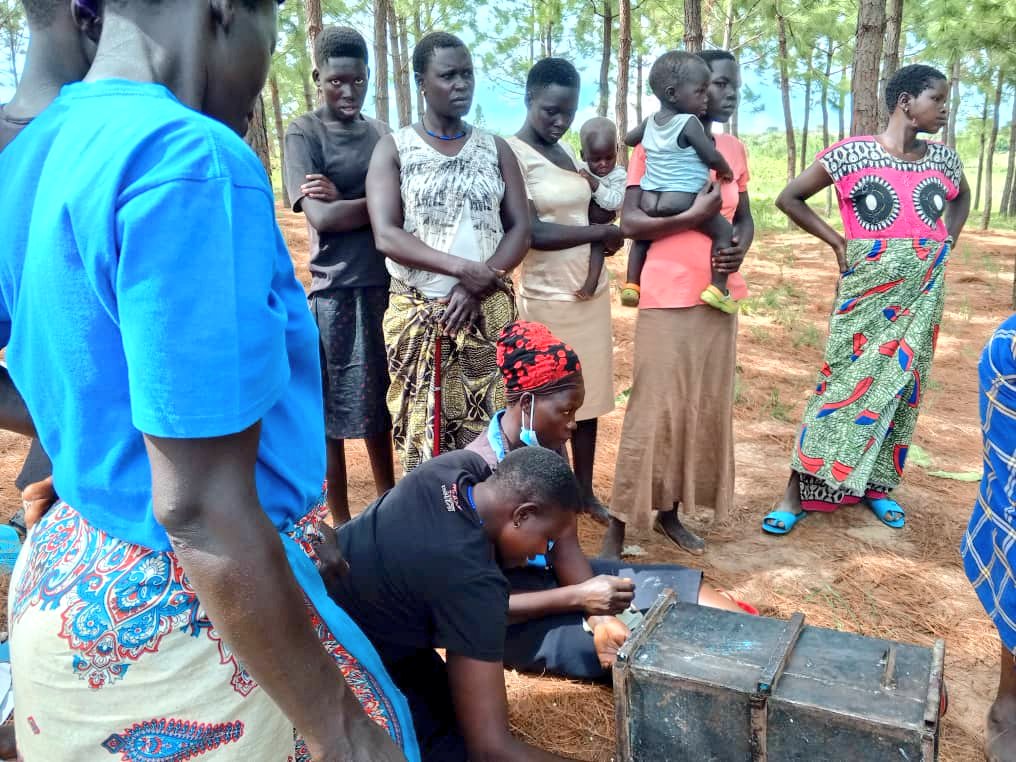
The training was not a lecture. It was a workshop — sleeves rolled up, hands in the mix, questions asked and answered in real time. Guided by skilled facilitators, participants moved through the entire soap-making process from start to finish: proper chemical handling and safety during the mixing stage, quality control, moulding, curing, and packaging for market. They didn’t just learn to make soap. They learned to make sellable soap — a product that every household needs, every day, without exception.
What set this training apart was its insistence on the full picture. Beyond the technical process, participants received grounding in practical business education: how to price a product correctly, how to understand your market and your competitors, how to build consistent quality that earns buyer trust, and — critically — how to translate a skill learned in a single training session into a small business that generates recurring income month after month. Women discussed together how to pool resources through their VSLA groups, reduce production costs through collective purchasing, and access larger markets including schools, health facilities, and local retail outlets.
The room was alive with possibility. Women who arrived uncertain left with clarity — and with plans already taking shape, minds calculating what their first batch would cost, what it would earn, and what they would do with the difference.
“We didn’t just learn to make soap. We learned that we have the power to build something for ourselves — and for our children.”
Participant Reflection · Alarapi-Asianzu Women VSLA GroupWhat We Achieved
Outcomes That Will Last
The results of this training go beyond what any table can fully capture. They live in the confidence of participants, in conversations that continued long after the session ended, and in plans being made across Pakayo and Alarapi. But there are concrete outcomes worth naming clearly.
Practical Skills in Bar Soap Making
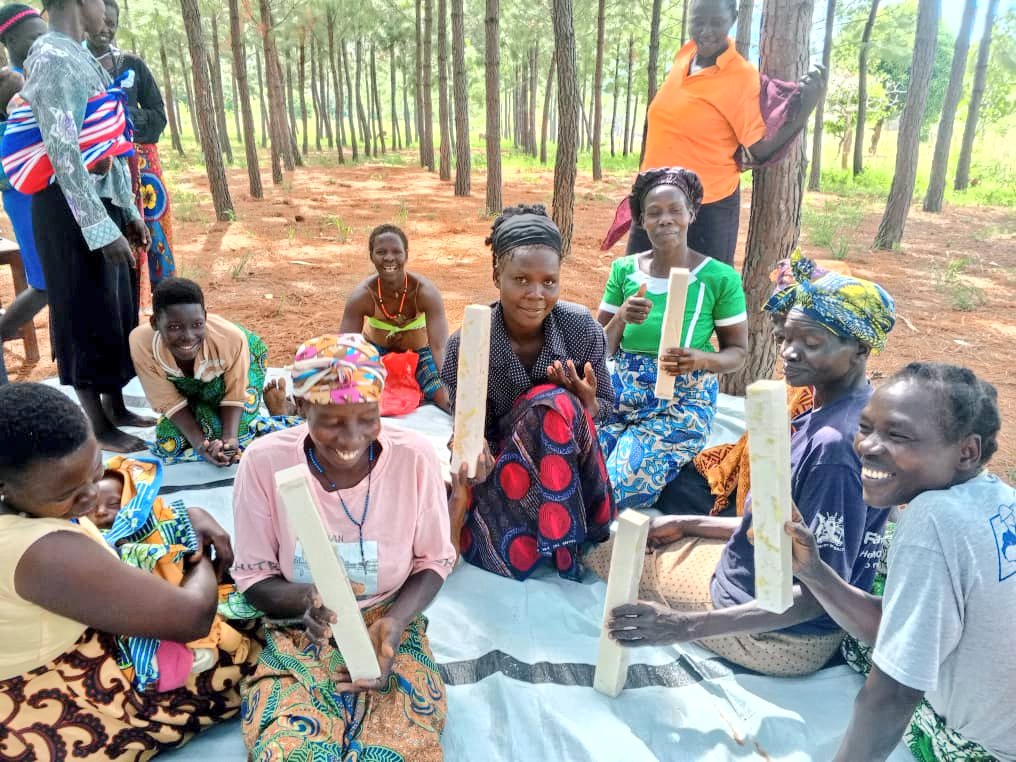
Women and girls in both VSLA groups acquired comprehensive hands-on knowledge in bar soap production. From raw materials to a finished, packaged product, participants now hold a skill they can use tomorrow — and every day after that. This directly enhances their capacity for income generation and strengthens their ability to save and invest through their VSLA groups.
Safe Chemical Handling
Working with caustic soda and other chemicals requires care and precision. Participants gained critical knowledge in safe handling, correct proportioning, and protective practices during the soap production process — skills that protect their health, ensure product consistency, and position them as credible and professional producers in the eyes of buyers.
Business Mindset and Entrepreneurship
Technical skill without business knowledge is a half-built bridge. The training closed that gap. Participants left with a working understanding of pricing, market strategy, quality management, and customer trust — the foundational elements of any sustainable small enterprise. Many were already identifying their first customers before the session was over.
Aspiration to Diversify Income
One of the most encouraging outcomes was the appetite the training created for more. Participants expressed strong interest in learning liquid soap and shampoo production, seeing these as natural extensions of their newly acquired skills. Diversified products mean diversified income — and reduced financial vulnerability across seasons and shifting market conditions.
Strengthened VSLA Solidarity
Training as a group deepened the bonds within both VSLAs. The conversations that unfolded in the workshop — about quality, about markets, about supporting one another — are exactly the kind that transform a savings group into a resilience network. This social solidarity is itself a protective factor: connected women are less isolated, and less isolated women are safer.
Who We Reached
57 Women. Countless Ripples.
The training directly reached 57 women — 30 from Alarapi Parish and 27 from Pakayo Parish. Among those reached were 9 women living with disabilities, reflecting the project’s deliberate commitment to inclusion and to leaving no one behind. All participants were members of the host community, ensuring that skills and economic momentum remain rooted in the local fabric of West Nile.
These 57 women are not just individual beneficiaries. They are mothers whose children will eat better. They are daughters showing the next generation what independence looks like. They are neighbours whose small businesses will circulate money and opportunity through their communities. Each skill learned ripples outward — and in a sub-region carrying the weight of West Nile’s GBV statistics, every ripple matters.
| Age Group | Host Community (Female) | Women with Disabilities | Total Reached |
|---|---|---|---|
| 18 – 25 years | 16 | 4 | 20 |
| 26 – 34 years | 16 | 2 | 18 |
| 35 years and above | 16 | 3 | 19 |
| Total | 48 | 9 | 57 |
Looking Forward
The Economic Impact We Expect
Bar soap is not a luxury product. It is a daily necessity in every household — its demand is constant, its market is everywhere, and its production requires minimal equipment to begin. A woman who masters soap making and has access to start-up capital through her VSLA can begin generating income within days of completing training. When VSLA members collaborate — pooling resources to buy raw materials in bulk, sharing equipment, dividing production tasks — the economics improve further: lower costs, higher margins, more consistent quality, and access to institutional buyers that individual producers could not reach alone.
The immediate economic impact is household-level but real: money for school fees, money for healthcare, money set aside in savings that grows month by month. The medium-term impact, as women build customer bases and grow their enterprises, extends outward into their communities — creating local employment, stimulating the small trader economy, and demonstrating to other women that financial independence is not a dream. It is a skill and a plan away.
But perhaps the most significant economic impact is the one hardest to measure directly: the reduction in the cost of gender-based violence itself. GBV carries enormous economic weight — in lost productivity, in healthcare costs, in the trauma that passes from one generation to the next. Research confirms consistently that women who control their own income are better positioned to make decisions about their safety, to demand respect in their households, and to exit situations of violence when they become untenable. Every woman who earns her own income is, in a very real sense, investing in her own protection.
With the right follow-through — access to start-up capital, ongoing mentorship, and the additional skills trainings participants are already requesting — these 57 women are positioned to become proof of concept for the whole of West Nile. That safety and economic independence are not separate goals. That they are, in the end, the same journey.
There Are More Women Waiting.
Will You Walk With Them?
The women of Pakayo and Alarapi are just the beginning. Across West Nile, Amani Initiative works with many women’s groups under our Sustainable Livelihoods and Empowerment programs — groups that are ready to learn, ready to grow, and ready to build safer, more independent lives for themselves and their communities.
If this story moved you — if you believe, as we do, that a skill can be a lifeline — we would love to hear from you. Whether you are an individual, an organisation, or a funder, there is a role for you in this work.
Reach out to us directly and let’s explore how we can work together.
✉ info@amaniintiative.orgAmani Initiative · Sustainable Livelihoods & Empowerment Programs