
One Meal Changed Everything for 1,800 Children
How a community in rural Uganda turned a simple idea into a life-changing school feeding program.
More than 500 kilometres from Kampala, in the quiet hills of Kijomoro Sub-County, something quietly extraordinary is happening every morning. Over 1,800 children arrive at Oribani Primary School in their uniforms — some having walked long distances — ready to learn. But not so long ago, many of those same children would disappear by midday, pulled away by a force more powerful than any teacher’s lesson: hunger.
The Silent Crisis in the Classroom
Uganda’s Universal Primary Education program provides a capitation grant of UGX 17,000 per child per year — roughly USD 1.50 per term. While this supports operational costs, it does not include meals. For families in Kijomoro, sending food to school was simply not possible.
The consequences were quiet but devastating. Learners missed school when there was no food at home. Others left at lunchtime and never came back. Those who stayed sat in class too hungry to concentrate, their potential slipping away one missed lesson at a time. Absenteeism climbed. Academic performance fell. Dropout rates rose. And for girls, the long unsupervised lunch break outside school created dangerous vulnerabilities — increasing the risk of early pregnancy and permanent dropout.
Research shows that school feeding programs can increase attendance by up to 8–9% in communities like this. At Oribani, hunger wasn’t just a welfare problem. It was an education crisis.
“Before the feeding program, many learners would disappear at lunchtime and some would not return. Others sat in class tired and unable to concentrate.”
— Ajuru Dorcus, Deputy Headteacher, Oribani Primary SchoolA Community That Refused to Accept It
Rather than wait for outside intervention, Oribani’s School Management Committee, the PTA, and the Old Boys and Old Girls Association came together and built something remarkable from within. They launched a community-supported school feeding program — structured, transparent, and entirely their own.
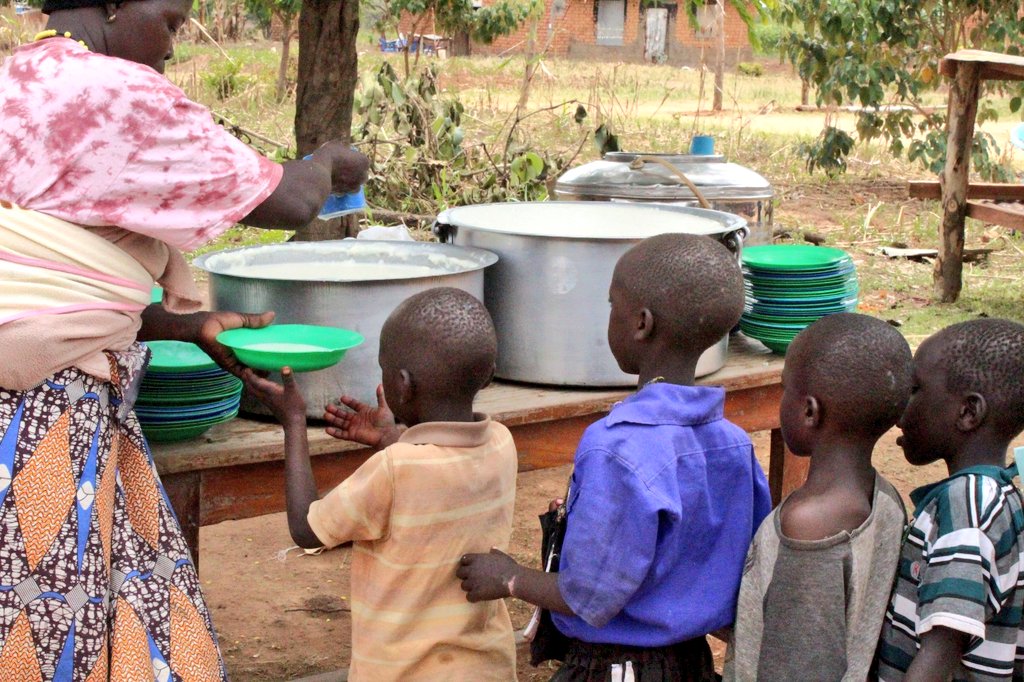
The cost to feed 1,800 learners for one 65-day term is UGX 6,700,000 — approximately USD 1,800. Just two dollars per child per term for a daily meal that keeps them in school. Parents contribute firewood. Alumni mobilise funds. Community members provide oversight. Local suppliers provide food, purchased in bulk at the start of term to stabilise prices. Designated cooks prepare meals on-site. Teachers supervise distribution and monitor attendance.
This is not charity. This is coordinated community leadership in action.
The Results Are Undeniable
Better Attendance
Learners are staying the whole school day — no more disappearing at lunchtime.
Stronger Focus
Teachers report better class participation and attentiveness across all grades.
Girls Protected
Supervised meal times remove the dangerous unstructured lunch break that put girls at risk.
Community Ownership
Built by the community, for the community — sustainable and rooted in local leadership.
“Before, when I felt very hungry, I would think about going home. Sometimes I could not understand what the teacher was teaching. Now we eat at school, and I can stay the whole day. I want to finish Primary Seven and continue to secondary school.”
— Primary Six Pupil, Oribani Primary SchoolIn those words lies the entire truth of this program. A daily meal has become the difference between leaving and staying. Between falling behind and moving forward. Between a life half-lived and a future fully pursued.
A Model Ready to Transform 20 Communities
Oribani Primary School is one of Amani Initiative’s 20 partner schools under the Empowered Voices Project, supported through the Girls First Fund. The success of this community-led model has sparked a bigger vision: to scale this program to all 19 remaining partner schools across the region.
The investment case is powerful in its simplicity:
The return on that investment? Improved attendance. Stronger retention and academic performance. Greater protection for vulnerable girls. And communities who are more deeply invested in the future of their children’s education than ever before.
“We have seen what is possible when a community comes together. With more partners, we can ensure that no child at Oribani — or in the other schools — has to choose between hunger and education.”
— Ajuru Dorcus, Deputy Headteacher, Oribani Primary SchoolThe most powerful intervention in education sometimes begins with something as simple — and as profound — as a daily meal. At Oribani, it already has. Now imagine what 20 schools could look like.
Support a School. Sponsor a Term. Change a Life.
Partner with Amani Initiative to bring this program to all 20 schools in our network. Every dollar feeds a child’s future.
Get in Touch → info@amaniinitiative.org